William (Bill) Maloney
Gallipoli
Beginning in early May 1915 the division joined the British Army Corps, from June known as VIII Corps, at Cape Helles following the failure of the Allies to achieve the anticipated swift success at Gallipoli during April.
On 26 May 1915 the division received its number, becoming the 42nd (East Lancashire) Division, and the brigades were also numbered, becoming 125th (1/1st Lancashire Fusiliers) Brigade, 126th (1/1st East Lancashire) Brigade and 127th (1/1st Manchester) Brigade.
The 125th (Lancashire Fusiliers) Brigade landed in time to participate in the Second Battle of Krithia on 6 May. The 126th Brigade arrived on 11 May.
The entire division was involved in the Third Battle of Krithia on 4 June. The division carried out the Helles diversion at the start of the Battle of Sari Bair in what became known as the Battle of Krithia Vineyard.
Captain William Thomas Forshaw of the 1/9th Battalion, Manchester Regiment was awarded the Victoria Cross for his actions in this battle from 7 to 9 August.
2nd Lieutenant Alfred Victor Smith of the 1/5th Battalion, East Lancashire Regiment was posthumously awarded the Victoria Cross for his action at Helles on 23 December.
The division remained at Gallipoli until the final evacuation of Helles in January 1916 but was severely depleted by casualties and illness.
42nd Division's casualties at Gallipoli were 395 officers and 8152 other ranks killed, wounded and missing.
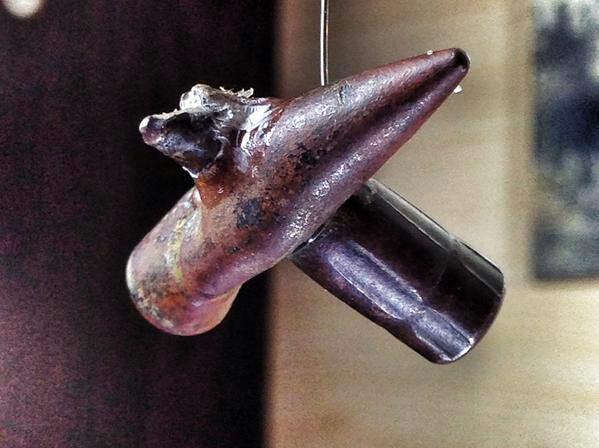
This incredible photo shows two bullets that were found after the Battle of Gallipoli.
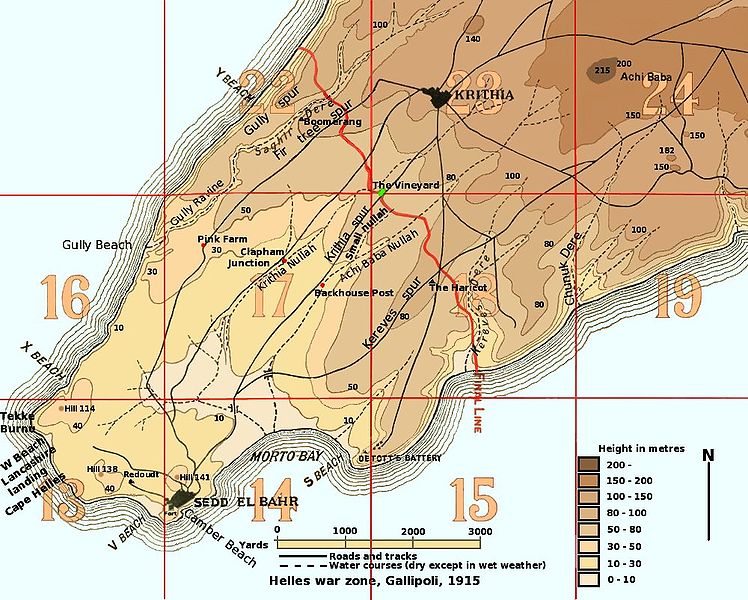
Map of Gallipoli in 1915.
The landing of troop at V Beach, Gallipoli by the SS River Clyde.
The SS River Clyde was a British collier (a bulk cargo ship designed to carry coal) built by Russell & Co of Port Glasgow on the Firth of Clyde and completed in March 1905.In the First World War the Admiralty requisitioned her for the Royal Navy and early in 1915 the River Clyde was adapted to be a landing ship for the joint French and British invasion of the Gallipoli Peninsula.
Openings were cut in her steel hull as sally ports from which troops would emerge onto gangways and then to a bridge of smaller boats from the ship to the beach. Boiler plate and sandbags were mounted on her bow, and behind them a battery of 11 machine guns was installed. The machine gun battery was manned by Royal Naval Air Service men commanded by Josiah Wedgwood.Work began on painting River Clyde's hull sandy yellow as camouflage, but this was incomplete by the time of the landing.
By 11 April 1915 River Clyde was in the natural harbour of Moudros on the Aegean island of Lemnos, where French and British ships were assembling in final preparation for the landings. The troop ship HMT Aragon reached Moudros from the Port of Alexandria in Egypt and transferred the 4th Battalion, the Worcestershire Regiment and the 2nd Battalion, the Hampshire Regiment to River Clyde. Both Battalions were units of the 88th Brigade, which was part of the 29th Division
On 25 April 1915 River Clyde sailed to take part in the landing at Cape Helles. She was commanded by Commander Edward Unwin formerly of the Dryad-class torpedo gunboat HMS Hussar. She was carrying 2,000 soldiers, mostly from 86th Brigade units of the 29th Division, the 1st Battalion of the Royal Munster Fusiliers and men from the 1st Battalion, the Royal Dublin Fusiliers.
Unwin beached River Clyde at V Beach beneath the Sedd el Bahr castle, on the tip of the Gallipoli peninsula. The plan failed and the River Clyde, beached under the guns of the Turkish defenders, became a death trap. Three attempts to land made by companies of Munsters, Royal Dublins and Hampshires all ended in costly failure. Further landing attempts were abandoned and the surviving soldiers waited until nightfall before trying again. After the Helles beach-head was established, V Beach became the base for the French contingent and the River Clyde remained beached as a quay and breakwater. Her condensers provided fresh water and her holds became a field dressing station. She remained a constant target for Turkish gunners ashore.
In 1919, after the war had ended the SS River Clyde was refloated by the Ocean Salvage Co. and taken to Malta for repairs. The British Government refused a proposal to purchase her to return to the UK for mooring in the River Thames as a monument to the landings because of the cost. Consequently she was repaired at Malta and sold to civilian Spanish owners. She operated with a new name as a tramp steamer in the Mediterranean, first as Angela and then Maruja y Aurora. Maruja and Aurora were the names of the eldest child of each of the two partners in the company, Gumersindo Junquera Blanco and Vicente Figaredo Herrero.
She was seized by Spanish Nationalist forces at Santander in August 1937 and used by the Nationalist navy, during which time she captures the steamship Margarita. She made trips between Santander and Ferrol, and carried troops between Gijon and Bilbao. She was returned to her former owners 18 months later, and she resumed her previous commercial role, she rescued three British airmen during World War II.
In 1965 there was an attempt to buy and preserve River Clyde but the British Government were unwilling to purchase her, and in 1966 she was sold for £42,000 for scrap and broken up at Avilés, Spain
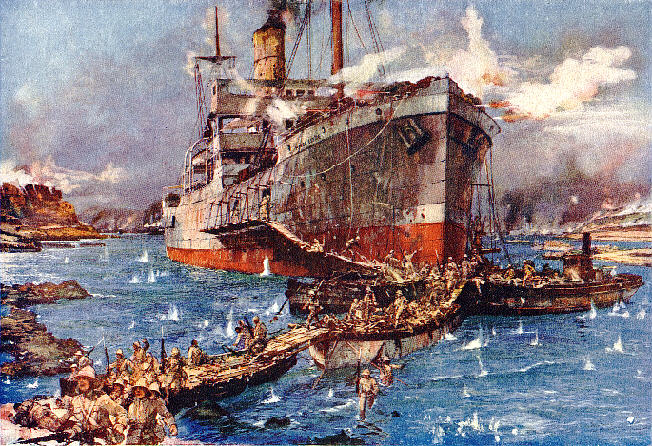
The Landing of troops from the SS River Clyde at V Beach Gallipoli. April 25th 1915 in a painting by Charles Edward Dixon.
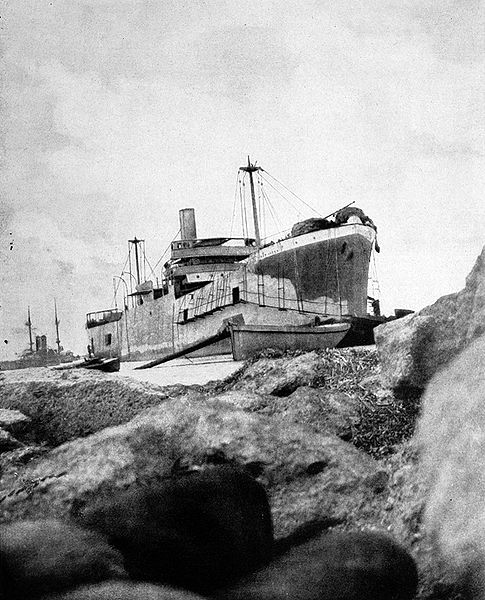
The SS River Clyde beached at Cape Helles, Gallipoli, 1915.
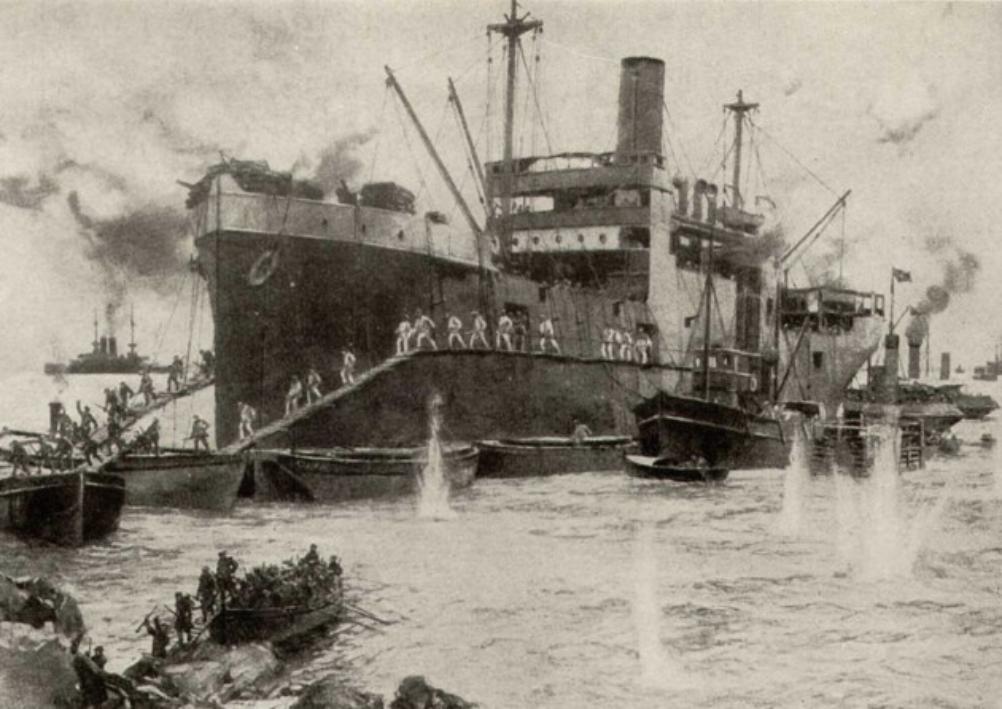
The SS River Clyde was a floating 20th Century version of the Trojan Horse
Copyright © Keith Maloney 2010 - 2022